With
the death of former US First Lady Nancy Reagan on March 6, 2016, age 94, it is
a good opportunity to reflect on the legacy of her husband, former President
Ronald Reagan. For these two Hollywood actors, who had a half-a century love
affair, forged one of the most powerful and successful political partnerships
in American history. There are some potent leadership lessons we can learn.
But
first, let’s focus on Nancy Reagan.
As
First Lady, Nancy did not enjoy the popularity that her affable witty husband
had. She was accused of interfering with White House staff, being extravagant
in her White House and personal tastes, happily received expensive freebies,
and regularly consulted astrologers. In the 1991 best-seller Nancy Reagan:
The Unauthorised Biography, author Kitty Kelley wrote a scathing account,
claiming Nancy was mean-spirited to her father and stepchildren, formidable and
intimidating to staff, thoroughly ungrateful, and dependant on astrology. Most
shocking of all, Kelley accused Mrs. Reagan of being the ‘petticoat president,’
making presidential decisions because of her husband yet-undiagnosed mental
decline.
Such
accusations, even if they are true, overlook the bigger picture. Next to her
husband, Nancy was the most important pillar of the Reagan Administration, one
that enjoyed some historic successes.
First,
it reinvigorated US economy. ‘Reagonomics' ignited a long boom that carried on
for years to come.
Second,
the Reagan Administration, like Nehemiah of old, helped lift the nation’s morale.
The national malaise was easy to understand: The long night of 1960s rebellion
- the most violent decade is US history apart from the Civil War - the Vietnam
War debacle, the Watergate scandal that brought down the Nixon presidency, and
the Carter Administration’s perception of weakness in the face of the Iranian
hostage crisis. America needed a cheer-leader and Ronald Reagan, the ‘Great
Communicator,’ fulfilled that role to the hilt. His buoyant optimism was
contagious. In 1992, three years out of office, Reagan brought the house down
when he declared: America’s best days are yet ahead.
Third,
on the moral front, President Reagan was consistently and staunchly pro-life.
Apart from his memoirs, he wrote a book about it called Abortion and the
Conscience of a Nation. His pro-life convictions were not universally
shared, even by his cabinet or family. But he stuck to them because he believed
they were right. He single-handedly and successfully fought Congress to limit
government funding of abortion.
Ronald
Reagan also instilled a new respect for the US military, which helped him in
his greatest achievement: Bringing a peaceful end to the Cold War. He showed
courage in the face of challenge, conviction when others compromise,
consistency where others caved in to expedience, and candour where others
settled for politically correct spin. He called the Soviet Union an ‘evil
empire,’ brought them to the negotiating table, outspent and outgunned them.
Then
there was the Berlin Wall, the 160 km concrete barrier around West Berlin that
symbolised the imprisonment of the Soviet bloc nations. Reagan came to Berlin
in 1987 and said the immortal words at the Brandenburg Gate: Mr. Gorbachev,
tear down this wall. Two years later, the notorious Wall fell and so did
Soviet Communism in Europe and the USSR. (Ironically, the Nobel committee
awarded the Peace Prize to Mikhail Gorbachev, last President of the Soviet
Union, ignoring Reagan’s key role in ending the Cold War). Yet even if the
Nobel committee overlooked Ronald Reagan, East Europeans did not. When he died
in 2004, many East Europeans came to the US Capitol to pay their respects to
the man who set their country free
The late US
Senator Edward ‘Teddy’ Kennedy (1932-2009), a political opponent of Reagan,
gave this tribute: ‘…. Whether we agreed with him or not, Ronald Reagan was
a successful candidate and an effective President above all else because he
stood for a set of ideas. He stated them in 1980 — and it turned out that he
meant them — and he wrote most of them not only into public law but into the
national consciousness.’
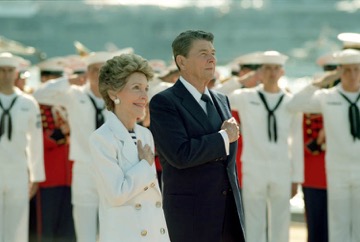
Nancy
Reagan was no spectator in all this. She was highly intelligent and
convincingly loyal to her husband, both during his tenure as Governor of
California, President of the United States, and during his ‘long good-bye’ with
Alzheimer. Her signature work in the White House was an anti-drug campaign
called ‘Just Say “No.”’
After
‘The Great Communicator’ gave the nation his last message, announcing he had
Alzheimer, in 1994, Nancy became the gracious family spokeswoman from that time
until her death. She helped raise millions of dollars for Alzheimer’s research.
And she was a devoted patron to the Reagan Library in Simi Valley, California,
where, as she put it, young people can learn the benefits of democracy. As
close friend, the late Michael Deaver said, without Nancy there would have been
no ‘Governor Reagan’ or ‘President Reagan.’
Who
said that great leaders have to be flawless? We need to realise that great
leader’s can often have great faults (don’t forget that Winston Churchill had a
particular fondness for alcohol - yet he saved Britain and Europe). The such a
leader contains or overcomes their faults, while using their gifts to the
maximum in times of need or opportunity. Whatever the shortcomings of Ronald
and Nancy Reagan, they led America and the world into a new era of prosperity
and peace that still pays dividends.
As
First Lady, Nancy was a vital part of a leadership team that serves as a role
model even to this day. Conviction, courage, consistency, and character, were
the hallmarks. As Americans, Australians and the world face an election year
and wonder ‘Where are the real leaders?,’ many can rightly look back to the
Reagan era as one of leadership that makes the a world of difference.
Comments
Post a Comment